Engineering living tissue with AI-guided microfluidics.
XLab combines a coaxial microfluidic nozzle with predictive AI models that set safe, accurate flow rates before printing — improving reproducibility, reducing waste, and accelerating the path from organ-on-chip models to implantable bio-hybrid systems.
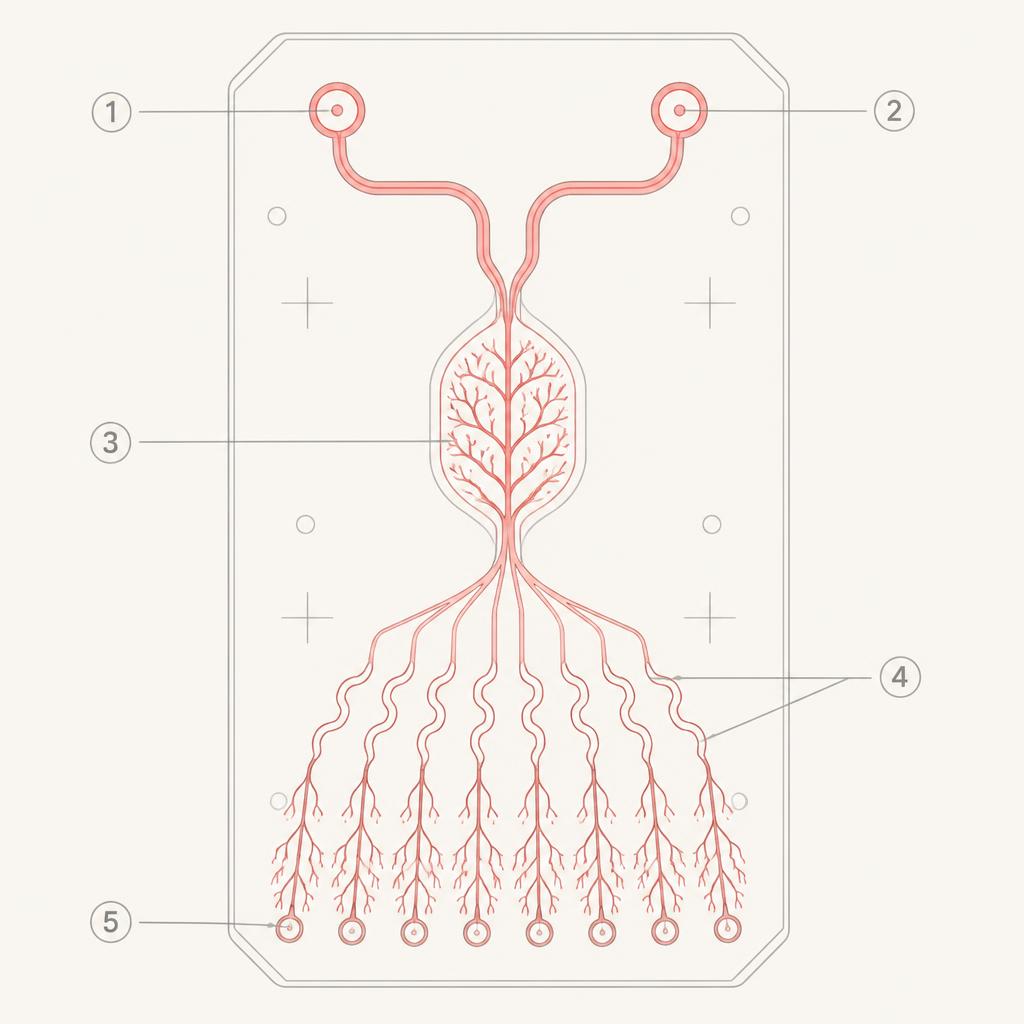 Fig 01.1: Neural-Fluidic Chip
Bioprinting must be precise, stable, and reproducible.
Current 3D bioprinting techniques struggle to reliably fabricate high-resolution, structurally stable tissue and implant constructs. Precise control of microfluidic flow, nozzle velocity, and molecular transport is computationally expensive, error-prone, and difficult to scale — leading to low reproducibility, safety concerns, and slow design iteration.
This affects academic labs, hospitals, and biotech companies working in regenerative medicine, tissue engineering and drug testing. The global 3D bioprinting market is valued in the billions and growing rapidly, yet scalability and reliability remain major bottlenecks to clinical translation and personalised medicine.
AI-assisted microfluidic control, before the first layer.
XLab's intelligent microfluidic bioprinting system combines a specially designed coaxial printing nozzle with an AI-assisted control method that automatically adjusts how fast different bio-materials flow during printing. This ensures delicate tissue structures keep their shape instead of collapsing or deforming.
The core innovation is a new way to predict and control material flow before printing starts. Instead of slow trial-and-error experiments, fast mathematical models learn from physics and data to determine the safest, most accurate printing settings — with uncertainty estimation showing how reliable each print will be before it is made.
Published foundational work at Imperial College London supports this approach:
Microfluidics for 3D printing →AI-Assisted Microfluidic Bioprinting
Our platform replaces slow trial-and-error with predictive control. By combining a coaxial microfluidic nozzle with physics-learning AI, we set optimal printing parameters before the first layer is laid — improving reproducibility, reducing waste, and enabling scalable tissue and implant production.
Concentric Bio-Material Routing
A purpose-built microfluidic printhead that routes multiple biomaterials through concentric channels, enabling stable, high-resolution multi-material constructs.
Physics-Learning Models
Fast mathematical models learn from fluid physics and print data to determine the safest, most accurate flow rates and nozzle velocities before printing begins.
Reliability Before Printing
Built-in uncertainty estimation quantifies predicted print reliability, flagging risky settings before material is wasted and supporting safer clinical translation.
Development Pipeline
Single- & Multi-layer Tissue Constructs
Status: Active Development / Validation
Bio-Hybrid Implants
Status: Clinical Trials Prep
Autonomous Organs
Status: R&D Horizon
“Thank you for your interest in Cambridge Social Venture Weekend! Your venture meets the criteria to join us.”
“The Royal Academy of Engineering has considered your first-stage application for Enterprise Fellowships and I am pleased to inform you that you can now access stage 2 application.”